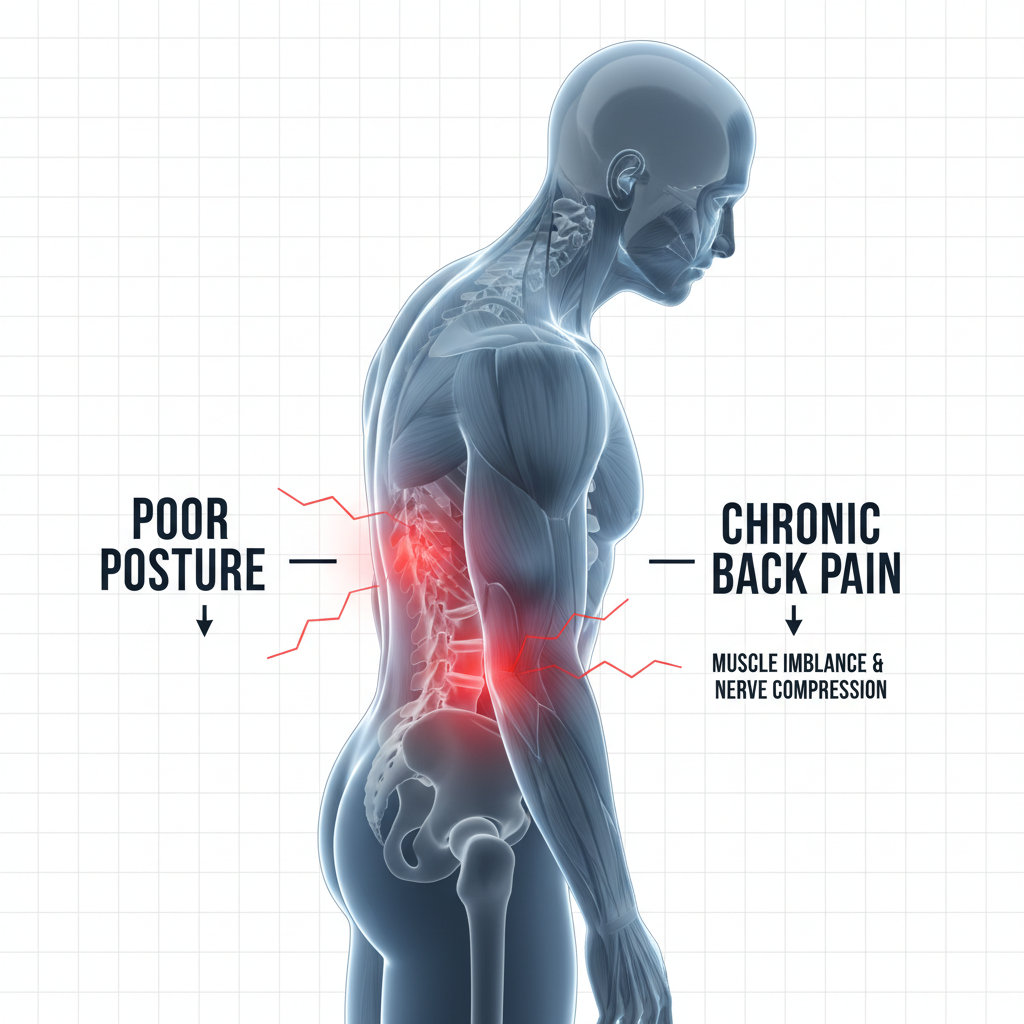
Poor Posture Back Pain Causes: Why Slouching Hurts More Than Your Back
Your back feels fine in the morning. By midafternoon your shoulders have crept up toward your ears and your neck feels like it is balancing a bowling ball. When you get home and your child asks to be picked up, you brace before you bend. The poor posture back pain causes that Lucas Chiropractic sees hiding in your day are rarely dramatic: the laptop on the kitchen counter, the car seat you swing out one-handed, the phone you scroll with your chin dropped to your chest. Each one is small, but stacked together day after day, they change how your spine carries weight, and that change rarely stays in your back.
If pain is making it harder to keep up with work and family, you are not being dramatic, and you are not stuck with it. This guide from Lucas Chiropractic at 2711 Randolph Road in Charlotte, NC, explains what may be happening inside your spine, why waiting can sometimes make correction harder, and what a realistic path forward might look like. Dr. Matt Lucas and Dr. Marsocci share more than 34 years of combined experience in full family chiropractic care. Chronic back pain, neck pain, lower back pain, hip pain, and joint pain, the conditions posture may sometimes contribute to, are a core part of their daily work.
What Are the Real Poor Posture Back Pain Causes? Your Spine May Be Carrying a Load It Was Not Built For
Poor posture may cause back pain by moving your body weight off your spine’s strongest lines of support, though individual responses vary. That shift can force your muscles, ligaments, and discs to carry a load they were not designed to hold all day. The further your head and shoulders drift forward, the harder everything behind them may have to work.
Start with your head. A widely taught rule of thumb in spinal rehabilitation holds that every inch your head moves forward of your shoulders adds roughly 10 pounds of effective load on your neck, though this effect varies from person to person. Picture your head sitting three inches forward while you answer email. The muscles at the back of your neck may work as if they are holding up a heavier object, hour after hour. Because they may not get a break, they can tighten, ache, and sometimes start to burn between your shoulder blades.
That forward head rarely travels alone. It often comes with a pattern called upper crossed syndrome. Your chest muscles and upper trapezius can grow tight and short, while the deep muscles in the front of your neck, along with the rhomboids and lower trapezius in your mid-back, may grow weak and long. Your shoulders may round, your upper back can curve forward, and your levator scapulae (the muscle running from your neck to your shoulder blade) may stay in constant tension. This is why some people with poor posture feel it most in the upper back and at the base of the skull.
Your body may then compensate further down. Long hours of sitting can shorten your hip flexors and quiet your glutes, which may tip your pelvis forward and increase the arch in your lower back. The small joints and discs in your lumbar spine can then take on extra stress. The OSHA Technical Manual identifies awkward postures and postures held for long periods as recognized risk factors for back disorders, and a typical desk day combines both.
Over months and years, that steady load can stress your discs and may contribute to early wear in some people. Lucas Chiropractic uses digital X-ray in the office so the doctors can see your spinal curves, the spacing between your vertebrae, and any signs of degeneration. Your plan then rests on what your spine actually shows. Neck pain, upper back tightness, a lower back ache after sitting, and stiff hips may sometimes be one connected pattern, not four separate problems.
Why Do Charlotte Parents and Their Kids So Often Slouch the Same Way?
Once you see posture as a pattern, it becomes easier to spot at home too. Posture is a habit, and households share habits. When a family spends weekdays seated at desks, in cars, and on screens, adults and kids may develop the same forward head and rounded shoulder pattern at different speeds.
Think about a typical Charlotte week. Many parents work long hours in a chair, often followed by a commute in traffic. At home, the laptop moves to the couch or the kitchen island for one more hour of catching up. Your kids do homework on Chromebooks, game with their heads tipped down, and scroll their phones in bed. Nobody is doing anything wrong on purpose. The setup simply pulls everyone into the same shape.
Then the weekend arrives. You walk the greenways, coach youth soccer, haul coolers and folding chairs to the field, or spend Saturday on yard work. That mismatch between a sedentary week and an active weekend is where postural weakness may show up. Muscles that were switched off for five days suddenly have to stabilize you while you crouch, twist, and lift. It is common for some people to feel fine during the activity and then wake up Sunday barely able to get out of bed.
The Better Health Channel notes that poor posture habits such as slouching can lead to muscle tension and back and neck pain, and that good posture is a habit you can retrain. The pattern your family has built can also be rebuilt, though results will vary by individual.
If you notice your teenager sitting exactly the way you sit, that is worth paying attention to. Lucas Chiropractic treats patients from infants to seniors, and children’s chiropractic care is part of its whole-family approach, so you can address your own pain and have your child checked in the same office. Correcting a young person’s posture habits early may be easier than undoing decades of the same pattern later, though this varies by case.
Why Won’t an Adjustment Alone Fix Years of Slouching?
Understanding where the pattern comes from also explains why quick fixes may fade. Chronic posture problems often exist in two places: the joints and the muscles that hold them in position. An adjustment may restore motion to a restricted joint, but if tight chest, neck, and hip muscles keep pulling you forward, they can drag your spine back into the old pattern within days.
Maybe you have tried a chiropractor before, felt relief for a couple of days, and then watched the ache creep back. That is a fair reason to worry this will be another round of time and money that might not stick. Sometimes the joints were addressed while the muscle imbalance holding the pattern in place was left alone. Think of straightening a fence post while the ropes tied to it are still pulling it sideways: the post will lean again.
This is where the two-doctor model at Lucas Chiropractic matters. The doctors have complementary specializations. Dr. Marsocci concentrates on soft tissue and extremities, which is the side of the problem that may keep pulling a posture pattern back into place. Dr. Lucas concentrates on pregnancy care and acupuncture, backed by fellowship credentials in acupuncture. For a working parent with neck tension and low back pain, the plan might pair chiropractic adjustments with Active Release Technique for tight chest and hip muscles. For a mother whose posture shifted through pregnancy and from carrying a baby on one hip, it might include pregnancy chiropractic care and acupuncture under Dr. Lucas.
Posture also involves more than your spine. Rounded shoulders can change how your shoulder joint moves, and a forward-tipped pelvis may change how your hips bear weight. The practice at Lucas Chiropractic treats extremity injuries of the shoulders, hips, knees, and elbows, so care can follow the full chain instead of stopping at your back. Graston Technique and manual therapy may release the restricted tissue that keeps pulling you out of alignment.
When the muscles are released and retrained, adjustments may have a better chance of holding, and that may help your relief last longer, though individual responses vary.
How Long Does It Take to Correct Posture-Driven Back Pain?
Some people need weeks to months, not a single visit, though timelines vary widely. Your timeline depends on how many years the pattern has been building, whether X-ray shows degenerative changes, your age, and how consistently you do your home exercises and habit changes between visits.
Lucas Chiropractic organizes care into four levels so you always know where you are and what comes next:
| Level of care | Main goal | What it usually involves |
|---|---|---|
| Relief care | Help calm pain so you may move and sleep more comfortably | Gentle adjustments, soft tissue therapy, and options such as acupuncture, intersegmental traction, or Class 4 robotic laser therapy when they fit your case |
| Corrective care | Address the pattern that may be contributing to the pain | Progressive adjustments, Active Release Technique or Graston Technique, exercise prescription, and postural retraining |
| Maintenance care | Help maintain the progress you have made | Less frequent visits, continued home exercises, and periodic rechecks |
| Preventative care | Support your ongoing spinal health | Ongoing habit support, nutritional counseling, and check-ins as your work, family, or activity level changes |
Early visits in Lucas Chiropractic relief care focus on helping you feel well enough to get through your day, though response to care varies. Once pain settles, corrective care moves into the deeper work, and exercise prescription comes in. You may be given chin tucks to wake up the deep neck muscles, shoulder blade squeezes to strengthen your mid-back, hip flexor stretches to undo hours of sitting, and glute work to support your pelvis. These exercises may help retrain muscle memory so your spine holds its position between visits.
Postural retraining covers the habits that may have contributed to the problem, including your desk setup, your lifting mechanics, and your phone use. The NIH Office of Research Services recommends keeping a neutral spine at your workstation, which usually means a monitor near eye level, feet supported, and your back against the chair. Raising your laptop on a stand or holding your phone at eye level may reduce the load on your neck every day.
Digital X-ray gives you a true before picture. When appropriate, a follow-up image lets the doctors at Lucas Chiropractic compare your spinal curves over time, so progress can be measured instead of guessed. A spine with years of degenerative change may need a longer corrective timeline than an early-stage pattern, and maintenance care may become more important to help prevent recurrence, though individual outcomes vary.
What Happens If You Keep Pushing Through the Ache?
If a few months of care feels like a lot, consider the alternative. Posture-driven pain may start as reversible muscle strain. Left alone for years, it can sometimes progress to stretched ligaments, stressed discs, and joint changes that may be harder to address. The longer the pattern runs, the less room there may be to correct it.
The World Health Organization identifies low back pain as the leading cause of disability worldwide. That is not meant to scare you. It is a reminder that persistent back pain can quietly grow into the kind of pain that may keep you off the field, out of the garden, and short with the people you love.
The progression may unfold in stages. First, muscles can fatigue and tighten from constant load, and that stage may respond to care. Next, the ligaments that stabilize your spine can stretch from being held in a slumped position, which may make the joints less stable. Over time, discs may absorb uneven pressure, and the small joints of the spine can sometimes begin to show wear. When pain has been building for many years, X-ray may be more likely to show these later changes, and they can limit how much correction is possible in some cases.
Posture is a risk factor you may be able to change. You cannot change your age or your genetics, but you can change how you sit, lift, and move. The MyHealthfinder guidance on preventing back pain points to staying active, lifting with your legs, and practicing good posture as practical ways to help protect your back.
You may feel you do not have time for this right now. That is understandable when you are holding a job and a household together, but the time you spend now may be less than the time chronic pain takes later.
Chiropractic care is not a substitute for medical care when warning signs appear. nidirect advises getting urgent medical help for back pain that comes with numbness around the groin, loss of bladder or bowel control, or pain after a serious fall. If you notice any of these, see a medical doctor right away.
What Whole-Person Posture Care Covers That Stretching at Home May Not
At Lucas Chiropractic, posture care can combine chiropractic adjustments, intersegmental traction, Active Release Technique, Graston Technique, manual therapy, extremity care, laser therapy, exercise prescription, and daily habit coaching into one plan tailored to your needs. Home stretches may help, but they may not be sufficient to address an established structural pattern on their own.
A whole person approach means your plan is built around your actual life. A desk worker may need work on the neck, upper back, and hip flexors, plus a workstation adjustment. A parent who lifts toddlers, laundry baskets, and car seats all day may benefit from improved lifting mechanics and core stability exercises. Someone in a physical job may need care that accounts for repeated bending and twisting, while a weekend coach may need the shoulders and hips moving well so the spine is not picking up the slack. The same diagnosis can call for a different plan depending on how you spend your hours.
This is holistic conservative management in practice. The goal is to help support your body’s ability to hold better alignment, using gentle care that is safe and comfortable, without surgery or reliance on pain medication, though individual responses to care vary. Because the practice at Lucas Chiropractic cares for every age, your whole household can be seen in one place, which matters when the same habits may be shaping everyone’s posture at once.
Cost is a real worry, especially before you know whether care might help. Lucas Chiropractic accepts Medcost, Bright HealthCare, Medicare, Cigna Healthcare, and BlueCross BlueShield, and the front desk can help you check your benefits and explain costs for your level of care before you commit to a plan. You deserve to know the numbers up front.
The Lucas Chiropractic office is at 2711 Randolph Road, Suite 203, Charlotte, NC 28207, an easy drive for families fitting appointments around work and school.
Questions Charlotte Parents Ask About Posture and Back Pain
Can poor posture cause permanent back damage?
Over many years, chronic postural stress may contribute to degenerative disc changes and joint wear that may not fully reverse in some people. Early care focused on muscle balance, joint motion, and better habits may help slow that progression in some cases. The sooner you address the pattern, the more room there may be for meaningful change, though individual results vary.
How long does it take to correct years of bad posture?
Some people need several weeks to a few months of corrective care, with longer timelines for chronic cases or spines showing degenerative change, though each person responds differently. Your age, the severity of the pattern, and how consistently you do your home exercises all may affect progress. Maintenance care afterward may help support the changes you have made.
Do I need X-rays to get treatment for posture-related back pain?
Not every patient needs X-rays. Digital X-ray, available in the Lucas Chiropractic office, may help measure spinal curves, spot degenerative changes, and track correction over time, which can be useful for longer-standing posture cases. Your clinical exam, including how you move, where you feel pain, and how your joints and muscles respond, also guides the decision.
Why does my upper back hurt when my posture is bad?
Forward head posture and rounded shoulders, often called upper crossed syndrome, may keep the rhomboids, levator scapulae, and the muscles along your mid-back under constant strain. Those muscles may be stretched and working continuously to hold your head up, so they can fatigue, tighten, and ache. That is why the pain often sits between your shoulder blades for some people.
Will stretching and ergonomic changes fix my posture back pain?
Stretching and a better desk setup may genuinely help, and they are part of many care plans. On their own, they may not be sufficient to address an established structural pattern or a deep muscle imbalance in some cases. Lasting change may come from combining hands-on care, such as adjustments and soft tissue work, with targeted exercise and new daily habits, though individual responses vary.
Can teenagers develop serious posture problems from phone use?
Yes. Hours of looking down at phones, gaming, and doing homework on laptops may contribute to forward head posture and a rounded upper back in some teens. The pattern often starts quietly and builds over time. Because young bodies and habits may adapt more quickly, addressing posture in the teen years may be easier than correcting it decades later in some cases, though this varies by individual.
Your First Step Is Finding Out What May Be Driving Your Pain
Tonight, try a simple check. Stand with your heels, hips, and shoulder blades against a wall. If the back of your head does not rest on the wall without tilting your chin up, your head may be sitting forward of your shoulders, and your neck and back may be carrying that extra load every day. It is not a diagnosis, but it may be a sign the pattern is worth a closer look.
The poor posture back pain causes that may matter most are not the moments you notice, but the hours you do not: the commute, the inbox, and the evening scroll. Relief may come from changing both how your spine moves and how your day is set up, not from one adjustment alone.
Schedule a posture evaluation with Dr. Lucas and Dr. Marsocci at the Lucas Chiropractic office on Randolph Road in Charlotte, NC, to find out whether your back pain may stem from structural distortion, muscle imbalance, or both. You will leave with a care plan tailored to your daily habits and long-term health goals. Call 704-362-3305 to book your visit, or email office@drmattlucas.com if that is easier during a busy workday.
Ready to Address What’s Really Causing Your Discomfort?
If you’ve been living with back pain and suspect your daily habits might be part of the problem, you don’t have to figure it out alone. The team at Lucas Chiropractic can help you understand exactly how posture is affecting your spine and create a plan tailored to your body’s needs. Taking that first step toward relief starts with a conversation about what you’re experiencing and what’s possible.
Individual results from chiropractic care vary and depend on many factors including the nature and duration of your condition, your overall health, and how consistently you follow your care plan.