
Understanding poor posture back pain causes
If you live with nagging aches in your neck, shoulders, or lower back, poor posture back pain causes are very likely part of the picture. When you slouch, hunch over devices, or sit for long periods without support, you place your spine in positions it was not designed to hold for hours at a time. Over months and years this can strain muscles, irritate joints and discs, and set you up for recurring pain.
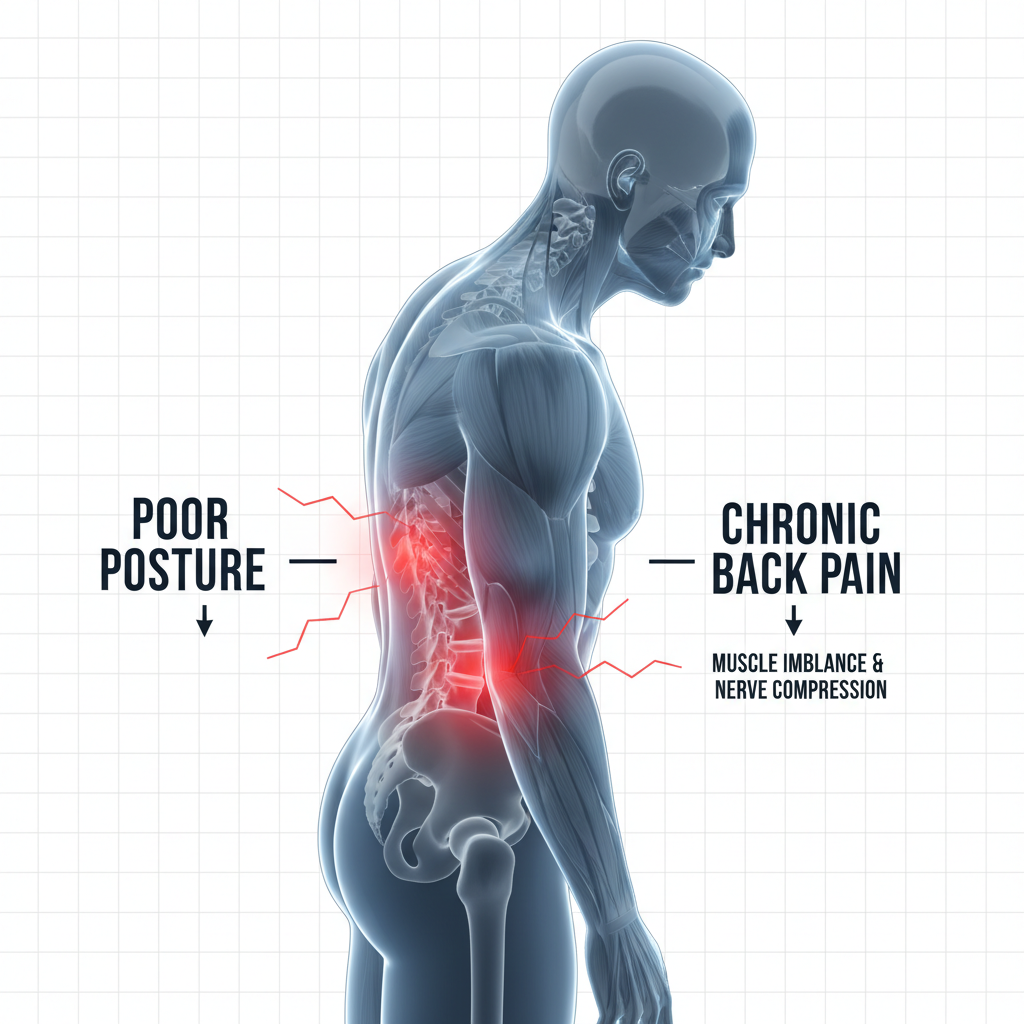
Poor posture does more than make you look slumped or tired. It changes how forces travel through your spine, alters muscle balance, and can even lead to degenerative changes in the vertebrae and discs over time [1]. Understanding how this happens helps you see why your pain keeps returning and what you can do about it.
If you want a deeper dive into other structural issues, you can also explore topics like what causes chronic back pain and why neck pain gets worse over time.
How posture affects your spine
Your spine is built to carry load best when its natural curves are maintained. Good posture keeps your ears, shoulders, and hips roughly in line. Poor posture shifts your body away from this neutral alignment, which changes how load is distributed through the bones, discs, and muscles.
When you slump, lean forward, or push your head out in front of your body, the vertebrae and surrounding tissues have to cope with forces in directions they are not meant to handle for long periods. Over time this extra demand becomes one of the most common poor posture back pain causes.
Excess stress on vertebrae and discs
In a neutral position, your vertebrae and discs share load efficiently. When you slouch or sit with a rounded back, that balance changes. Poor posture forces the spine into an unnatural alignment that puts excessive stress on the vertebrae and nearby muscles and ligaments. This extra stress can lead to pain, stiffness, and over time contribute to degenerative changes such as osteoarthritis and disc herniation [1].
Sitting is especially demanding on your discs. Research cited by OrthoNJ shows that disc pressure is higher when you sit than when you stand, and it increases even further if you lean or slouch forward [2]. If you already have bulging or degenerated discs, slouched sitting can aggravate them and trigger pain much faster.
Muscle imbalances and fatigue
Your muscles are designed to support the spine and share the load with passive structures like ligaments and discs. With poor posture, some muscles work much harder than they should while others become underused and weak. This imbalance is a major factor in poor posture back pain causes.
According to Hampton Roads Orthopaedics, poor posture overworks certain muscles and weakens others, which leads to joint pain, stiffness, and a reduced ability of your muscles to stabilize the spine. This further worsens spinal misalignment and creates a cycle that feeds on itself [1].
Holding a fixed position for a long time, such as sitting at a desk without moving, also leads to muscle fatigue and reduced blood flow. OrthoNJ notes that this combination contributes to stiffness and increased loading of spinal structures, which often shows up as pain when you finally stand up or try to move after sitting for hours [2].
Common poor posture patterns that cause pain
Not all poor posture looks the same. Certain recognizable patterns show up repeatedly in people with chronic pain. You might see yourself in one or more of these.
Forward head and “text neck”
Forward head posture, often called tech neck, is extremely common if you spend time looking down at phones, tablets, or laptops. In this posture, your head sits in front of your body’s vertical midline instead of stacked over your shoulders. Even a small forward bend in the neck can double or triple the load on your cervical spine [3].
This position forces the muscles in your neck and upper back to work against gravity all day. Over time they become tight, tense, and shortened, leading to neck pain, shoulder tension, and upper back discomfort [3]. You can read more about how this shows up in everyday life in resources like why does my neck hurt all the time and neck stiffness causes explained.
As muscles tighten and inflame, they can press on nearby nerves and create burning or tingling pain, numbness, or a sense of pins and needles in the neck, shoulders, arms, or hands [3]. Over years, chronic poor neck posture can further stress the discs and joints in the cervical spine and worsen conditions like cervical degenerative disc disease and cervical osteoarthritis.
Rounded upper back and kyphosis
If you habitually hunch over, you may develop an exaggerated curve in your upper back called thoracic kyphosis. While age-related changes, osteoporosis, arthritis, scoliosis, or previous injuries can drive kyphosis, modern sitting habits often aggravate or accelerate it [4].
A rounded upper back posture places excess pressure on the spine and can cause aching between the shoulder blades, upper back stiffness, and fatigue when you try to stand tall. In more severe cases, kyphosis can even interfere with breathing by restricting chest expansion [4]. This is one reason upper back symptoms are a key part of what causes upper back pain.
Swayback and tilted pelvis
Swayback posture happens when your pelvis tips forward or forward and down, while your upper body leans back to compensate. This position is often paired with tightened hip flexors and weak core muscles and glutes. The American Pain Institute notes that swayback posture is linked to low back pain, hip injuries, neck and shoulder pain, and can even contribute to problems with internal organs [4].
When your pelvis tips forward, your lumbar spine usually arches more than it should. This increases pressure on the facet joints and discs in the lower back. Over time this can become one of the key poor posture back pain causes that keeps your symptoms coming back.
Slumped sitting and “C” shaped spine
Extended slumped sitting is one of the most common patterns in office work, studying, or screen time. Instead of sitting with a gently curved lower back supported by the chair, you sink down and round through your entire spine into a “C” shape.
Research in adolescents shows that just 30 minutes of slumped sitting significantly increases lower back discomfort, especially in those who already have chronic low back pain. This position reduces the activity of deep trunk muscles like the internal obliques and multifidus, which means they do not protect your spine as well, while increasing stress on passive tissues like ligaments and discs [5].
OrthoNJ also highlights that sitting, especially with poor posture, increases disc pressure, muscle fatigue, and stiffness which all feed into back pain when you sit and when you try to move afterward [2].
Cross-legged sitting and pelvic rotation
Sitting cross-legged for long periods might feel comfortable, but over time it can rotate your pelvis and force your spine to compensate. Hartford HealthCare notes that extended cross-legged sitting can lead to muscle strain and hip or back pain because of this pelvic rotation and compensation pattern [6].
If you always cross the same leg over the other, you may also develop side-to-side imbalances that show up as one-sided lower back pain or hip discomfort. These asymmetries often contribute to recurring problems described in resources such as common causes of lower back pain.
Why poor posture leads to recurring pain
You might notice your pain temporarily improves when you stretch, exercise, or rest, yet it comes back as soon as you return to your usual workday or device habits. Poor posture back pain causes are often so embedded in your daily routines that the cycle keeps repeating until you address them directly.
Uneven load and tissue overload
When your posture is off, the load on your spine is not evenly distributed. Some areas absorb more pressure while others are underused. The American Pain Institute explains that this uneven load leads over time to stiffness, weakness, and stress on muscles, joints, and spinal discs, and can result in nerve problems and back pain [4].
Dr Vijay Vad notes that unsupported or incorrect postures during everyday activities such as sitting, walking, bending, and lifting cause the loads on the spine to disperse incorrectly. This can push muscles, discs, and joints beyond their tolerance and result in back pain. The stress builds up over time, weakening structures and causing ongoing pain unless you change how you use your spine [7].
Nerve and blood vessel compression
When you slouch or hunch, you do not just stress bones and muscles. You also change how nerves and blood vessels run through the tissues. The Pain Center reports that slouching and similar positions can constrict nerves and blood vessels in the back, leading to pain and problems with joints, muscles, and discs [8].
In the neck region, poor posture can inflame muscles that then press on nearby nerves, causing burning or stinging sensations, tingling, or numbness in the neck, shoulders, arms, or hands [3]. When nerves are irritated, you may feel symptoms in places that seem far away from your spine, which can be confusing if you do not realize posture is part of the root cause.
Disc compression and sciatica
Sustained poor posture can compress spinal discs, particularly if you sit or stand in one position without support for long periods. Spine.md notes that this compression can contribute to disc herniation and pinched nerves that cause pain radiating down the leg, commonly known as sciatica [9].
When a disc bulges or herniates due to ongoing pressure and strain, it can irritate nearby nerve roots in the lumbar spine. You may feel sharp or shooting pain, burning, tingling, or numbness in your buttock, thigh, calf, or foot. This is a clear example of how what starts as a posture problem can become a more serious structural issue, similar to those discussed in what causes chronic back pain.
Reduced healing capacity
Healthy tissues need good blood flow to repair everyday wear and tear. Poor posture reduces blood flow to spinal tissues, which impairs the ability of those tissues to heal and recover. Spine.md highlights that this reduction in blood supply may contribute to chronic back pain over time [9].
If you already have pain, you may also unconsciously adopt guarded or pain-avoidance postures to protect sore areas. While this can feel like a short-term solution, it often creates more muscle imbalance and weakness, feeding into a vicious cycle where pain and poor posture continually reinforce each other [9]. This is one reason why back pain keeps coming back for many people.
How lifestyle and work habits contribute
Posture does not exist in isolation. Your overall lifestyle, work setup, and activity patterns shape how easy or hard it is to maintain healthy alignment throughout the day.
Modern life encourages long hours of sitting, frequent device use, and minimal movement. These factors appear across many explanations for how lifestyle affects back pain and they directly amplify poor posture back pain causes.
Prolonged sitting and static positions
Simply sitting is not automatically harmful, but long periods of sitting combined with poor posture and other stresses can significantly increase your risk of low back pain. A systematic review found that sitting alone is not strongly linked to low back pain. However, when sitting takes up more than half your workday, and especially when it is combined with whole body vibration or awkward trunk positions, your risk of low back pain can increase up to fourfold [10].
Examples include:
- Drivers exposed to vibration from vehicles for many years, such as tractor drivers, who show a notable increase in low back pain and sciatica with long-term exposure [10]
- Occupations involving sustained trunk flexion, bending, or twisting while sitting, which can raise the odds of low back pain more than tenfold in some studies [10]
Even in non-vibration settings like offices or schools, holding a static sitting posture without ergonomic support leads to muscle fatigue, reduced blood flow, and increased spinal loading. OrthoNJ recommends practical adjustments such as an ergonomic chair setup, regular movement breaks, and potentially sit-stand workstations to reduce strain on your back [2].
Device use and non-ergonomic environments
Using mobile devices without ergonomic support, especially in environments like classrooms, couches, or beds, encourages slumped, unsupported positions. Jung and colleagues found that adolescents using mobile devices in slumped postures faced increased low back discomfort and muscle fatigue risk, particularly when their surroundings did not support good posture [5].
Similarly, Hartford HealthCare points out that common habits such as hunching over phones, sinking into couches, or slouching at desks increase wear and tear on the spine. These positions put extra stress on discs and ligaments and raise the risk of chronic back problems over time [6].
Weak core and lack of activity
Weak core muscles make it much harder for your body to maintain upright posture throughout the day. When your core cannot do its job, you unconsciously rely more on passive spinal structures like ligaments and discs for support. Hartford HealthCare notes that this shift in support increases your risk of back pain and encourages poor posture habits [6].
Spine.md also highlights that prolonged sitting, poor ergonomic setups, and a general lack of physical activity lead to weakened core muscles and tightness in other areas such as the chest and hamstrings. This combination creates a body that naturally falls into slouched positions and struggles to maintain healthy alignment [9].
Recognizing posture-related pain symptoms
Not all back or neck pain stems from posture alone, but certain patterns make it more likely that poor posture back pain causes are involved.
You may notice:
- Aching between the shoulder blades after working at a computer or driving
- Tightness or pain at the base of the skull or across the shoulders after using your phone
- Dull, stiff lower back pain that worsens after sitting and eases with gentle movement
- Pain that feels worse by the end of the workday and better after a weekend with more activity
- Symptoms such as tingling, numbness, or burning in the arms or legs if nerves are irritated
The Pain Center notes that posture-related back pain can vary widely. It may be sharp or sudden with particular movements, or it may build gradually depending on your activity, such as sitting, walking, or lifting [8].
Because posture interacts with many other causes, it can be helpful to read broader overviews like muscle tension vs spinal pain or common causes of lower back pain to see how your symptoms fit.
Practical steps to improve posture and reduce pain
Correcting posture is not about holding a rigid “perfect” pose all day. It is about learning more efficient positions, moving more frequently, and gradually strengthening the support structures that make good posture feel natural instead of forced.
Specific guidelines from Dr Vijay Vad on Spine-Health include:
- Sitting with back support and preserving your natural lumbar curve
- Walking tall with a straight spine and balanced head
- Lifting heavy objects by squatting with a straight back instead of bending at the waist [7]
OrthoNJ also emphasizes guideline-based care that focuses on strengthening core and hip muscles, improving flexibility, and gradually conditioning your body to reduce symptoms and prevent recurrence [2].
You can think of your plan in three parts: awareness, alignment, and activity.
Postural awareness takes time to build, but once it becomes more automatic, maintaining correct posture actually requires less effort than staying in poor posture patterns [7].
Build awareness of your patterns
You cannot change what you do not notice. Start by observing when your pain increases and what your body is doing at that time.
Ask yourself:
- How am I sitting when my back or neck starts to hurt?
- Do I always cross the same leg, lean on the same arm, or twist one way?
- What is my head doing when I use my phone or laptop?
- How does my posture change as I get tired during the day?
Simple cues like placing a reminder near your screen, setting alarms to check posture, or using a photo or mirror to check your alignment can raise your awareness without becoming obsessive.
Adjust your everyday alignment
You do not need fancy equipment to improve your posture. Small, consistent adjustments to your daily setup can significantly reduce strain.
For sitting:
- Sit with your hips back in the chair so your lower back is supported
- Keep your feet flat on the floor instead of tucked under you or crossed for long periods
- Adjust your screen so you do not have to crane your neck forward or tilt it down sharply
- Use a small pillow or rolled towel behind the low back if your chair lacks lumbar support
For standing and walking:
- Imagine a string gently lifting the crown of your head toward the ceiling
- Keep your shoulders relaxed, not pulled tightly back or rounded forward
- Distribute weight evenly across both feet rather than leaning on one hip
For devices:
- Bring the screen closer to eye level instead of bending your head toward it
- Hold your phone higher, at chest height, rather than in your lap
- Take frequent breaks to look into the distance and roll your shoulders
Increase movement and strength
Since static postures are part of the problem, regular movement is part of the solution. Short, frequent movement breaks are often more helpful than one long stretch session at the end of the day.
Consider:
- Standing up and walking for a few minutes every 30 to 60 minutes of sitting
- Gentle spinal movements such as cat-camel, pelvic tilts, or side bends
- Strengthening exercises for your core, hips, and upper back that can be done at home
Guideline-based rehabilitation approaches stress gradual conditioning and exercise as key tools for both relieving pain and reducing the chance it will return [2]. If you are not sure where to start, a physical therapist or rehabilitation specialist can design a plan tailored to your needs.
When to seek professional help
Although poor posture back pain causes are common, not all pain is just a posture issue. You should seek professional guidance if:
- Your pain is severe, sudden, or linked to a fall or accident
- You have weakness, significant numbness, or loss of control in your arms or legs
- Pain wakes you from sleep or does not improve at all with rest and gentle changes
- You experience unexplained weight loss, fever, or other systemic symptoms alongside back or neck pain
A clinician can help you determine whether your symptoms are primarily posture-related or whether other conditions, such as disc herniation, spinal stenosis, or inflammatory diseases, are involved. They can also guide you through the process of changing posture safely, especially if you have had pain for a long time.
If you are curious how your symptoms fit within the broader landscape of spinal issues, you may find it helpful to review topics such as why neck pain gets worse over time or why back pain keeps coming back.
Bringing it all together
Poor posture alone does not explain every case of back or neck pain, but it is an important and often overlooked piece of the puzzle. When your spine is repeatedly held in slouched, hunched, or twisted positions, vertebrae, discs, muscles, and nerves all experience stress that they are not designed to handle indefinitely. Over time this contributes to degenerative changes, muscle imbalances, nerve irritation, and recurring pain.
The encouraging part is that posture is modifiable. By understanding how your daily habits affect your spine, making small but consistent adjustments to how you sit, stand, and use devices, and gradually building strength and endurance in your support muscles, you can reduce the impact of poor posture back pain causes on your life.
Change will not happen overnight, but every step you take toward healthier alignment and more movement gives your spine a better chance to heal and function the way it was meant to.