
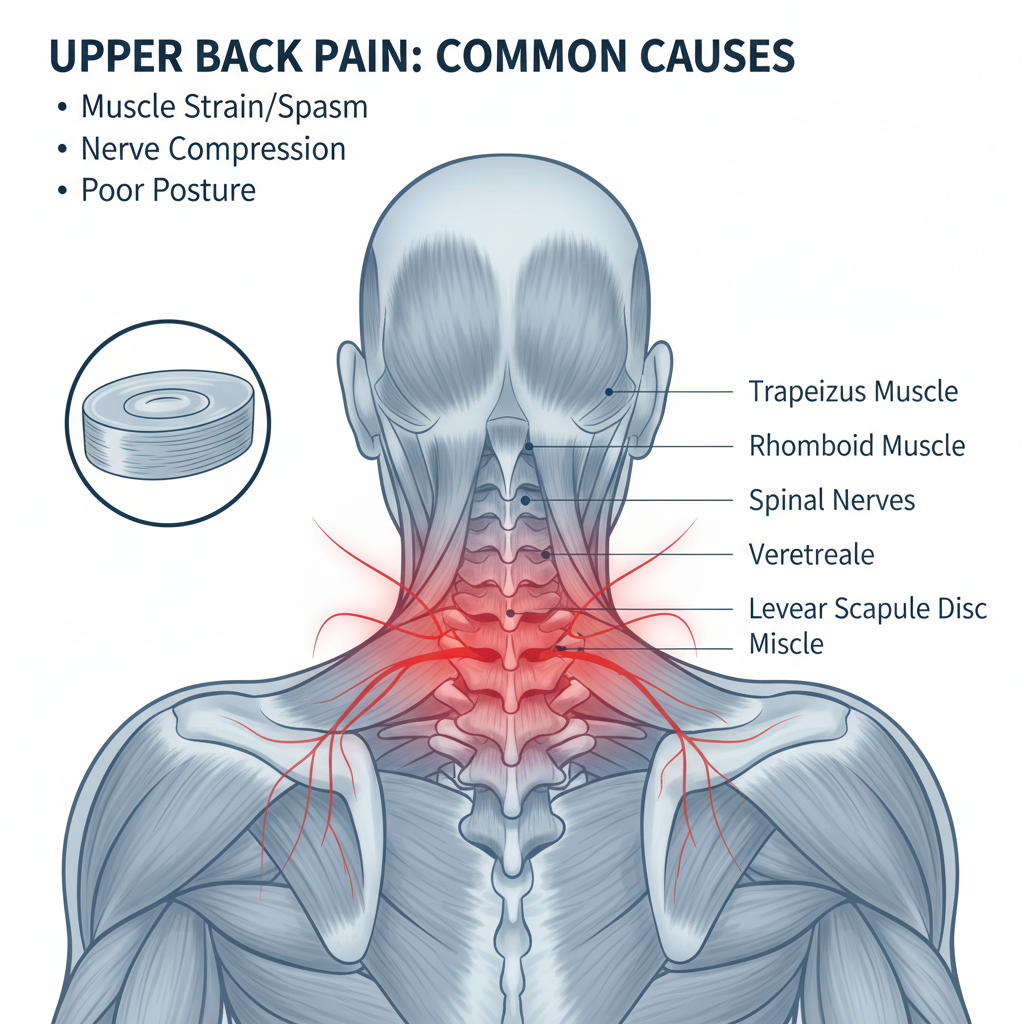
Understanding what causes upper back pain
If you live with recurring discomfort between your shoulder blades or from the base of your neck to your mid back, you might keep asking yourself what causes upper back pain and why it does not seem to go away. Upper back pain is common and can affect your work, sleep, mood, and ability to stay active.
Your upper back, also called the thoracic spine, runs from the base of your neck to the bottom of your rib cage. It is designed more for stability and support than for mobility, which means when something goes wrong in this area, it can be disruptive even if you are not twisting or bending a lot in daily life [1].
By understanding the most common causes, you can better recognize what might be driving your symptoms and when it is time to talk with a medical professional for a personalized evaluation.
How your upper back is structured
To understand what causes upper back pain, it helps to look briefly at how this part of your spine is built and what it is supposed to do.
Your upper and middle back include:
- Twelve vertebrae that stack from your neck down to your lower back
- Discs that sit between the vertebrae to absorb shock and allow small movements
- Muscles that support your spine and help you move your shoulders and ribs
- Ligaments that connect bones and add stability
Problems with any of these structures can lead to pain, stiffness, or a feeling of tightness across the upper back [2].
Unlike your neck, which is very mobile, the upper back is anchored to the rib cage. This design protects key organs, but it also means that when you develop pain here, you may feel it with activities as simple as sitting, standing, or taking a deep breath.
If you also notice discomfort higher up, it can help to understand why does my neck hurt all the time or to review neck stiffness causes explained, since neck and upper back issues often overlap.
Lifestyle and posture related causes
For many adults, everyday habits are a major factor in what causes upper back pain. Your posture, how long you sit, and how you use your phone or computer can set the stage for ongoing discomfort.
Poor posture and muscle strain
Poor posture is one of the most common contributors to upper back pain. When you slouch, hunch forward, or sit with rounded shoulders for long periods, you place uneven strain on the muscles and ligaments that support your spine. Over time, this can lead to:
- Muscle fatigue and tightness
- Imbalances between the front and back of your body
- Structural changes in how your spine curves
Research shows that poor posture can cause muscle deconditioning in the upper back, weaken the supporting muscles, and contribute to pain [3]. Slouching or hunching misaligns the spine, increases pressure on the joints, and may lead to inflammation and joint wear [4].
If posture is a concern, you can learn more about poor posture back pain causes and how they relate to your symptoms.
Sedentary lifestyle and “text neck”
Long days at a desk, driving, or relaxing on the couch without much movement can weaken the muscles that stabilize your upper back. A sedentary lifestyle also encourages postures like:
- Leaning over a laptop
- Reaching forward to type or use a mouse
- Looking down at your phone for extended periods
These habits, often called “text neck” when they involve your phone, increase the likelihood of developing poor posture and upper back pain [4]. Over time, the combination of inactivity and awkward positions can lead to muscle deconditioning in the upper back and increased curvature of the thoracic spine [5].
If you notice that your pain worsens on workdays or after screen time, lifestyle factors could be a significant piece of the puzzle. You may find it helpful to explore how lifestyle affects back pain to see where small changes could make a difference.
Overuse and repetitive strain
On the other side of the spectrum, repeated use of the same movements without enough rest can irritate the muscles and soft tissues of the upper back. Muscle overuse from repetitive motions, such as lifting, pulling, or specific sports activities, can gradually weaken muscles and lead to pain [5].
You might notice this if you:
- Work in a job that involves frequent lifting or reaching
- Do the same exercise moves without varying your routine
- Start a new activity too quickly, without building strength first
In these situations, the pain often builds slowly, can feel like tight bands across the back, and tends to worsen with continued use.
Structural problems in the spine
Sometimes what causes upper back pain has more to do with changes inside the spine itself. These structural issues often develop gradually but can lead to persistent or more intense symptoms.
Herniated or bulging discs
Between each vertebra in your spine sits a disc that acts like a cushion. When a disc breaks down, shifts, or bulges, it can put pressure on nearby spinal nerves and cause pain. Although herniated discs are more common in the lower back, they can occur in the upper back as well [3].
If a disc herniates in your thoracic spine, you might notice:
- Localized pain in the upper back
- Pain that radiates around your ribs or into your chest
- Numbness, tingling, or weakness in your arms or legs if nerves are compressed
Disc related pain is often sharper and may worsen with certain movements, deep breathing, or prolonged positions.
Degenerative changes and osteoarthritis
As you age, the cartilage that cushions the joints in your spine can gradually wear down. This process, known as osteoarthritis, may cause the bones in your spine to rub together and can put pressure on the spinal nerves. The result is bone pain, stiffness, and potentially numbness in the arms and legs if nerves are affected [3].
Osteoarthritis in the thoracic spine can lead to:
- A dull, aching pain in the upper back
- Stiffness, especially in the morning or after sitting
- Occasional catching or grinding sensations with movement
Similar degenerative changes are also a key factor in what causes chronic back pain, including in the lower back.
Spinal alignment and curvature issues
Poor posture, muscle weakness, and certain conditions can increase the curvature of your upper back over time. This can place extra strain on joints and soft tissues and eventually cause pain between the base of your neck and just below your rib cage [5].
Scoliosis and other curvature disorders can also affect the thoracic spine. When the spine curves abnormally, one side of your upper back may carry more load, which can lead to chronic muscle tension, fatigue, and localized soreness.
Muscle and soft tissue pain conditions
Not all upper back pain comes from joints or discs. Sometimes, the main issue is within the muscles and the connective tissue surrounding them.
Myofascial pain syndrome
Myofascial Pain Syndrome (MPS) is a chronic muscle pain condition that often affects the upper back. It usually develops after injury or prolonged muscle overuse. In MPS, pain persists longer than you would expect from a typical strain or sprain, and you may feel:
- Tender knots or trigger points in your upper back muscles
- Pain that is dull, aching, or deep
- Discomfort that gets worse with stress or certain movements
Physical therapy, stretching, and targeted treatment can help ease MPS and restore more normal muscle function [3].
Muscle tension versus spinal pain
It can be hard to tell whether your pain comes mainly from tight muscles or from deeper spinal structures. In reality, both often play a role. Tight or overworked muscles can pull on the spine and joints, while joint or disc problems can cause surrounding muscles to tighten in response.
Understanding the difference between muscle tension vs spinal pain can help you describe your symptoms more clearly to your provider and guide you toward the right treatment options.
Injury related causes
Sometimes what causes upper back pain is a more specific event, such as a fall, accident, or sports injury. In these situations, pain may start suddenly or show up in the days following the incident.
Traumatic injuries and compression fractures
Traumatic injuries, including falls or car accidents, can cause immediate or delayed upper back pain. These injuries may lead to:
- Fractured vertebrae
- Ligament sprains or tears
- Muscle strains or contusions
- Nerve damage
In more serious cases, traumatic injuries can result in chronic pain, nerve damage, or even paralysis [5].
Compression fractures are another important cause of upper back pain. They occur when a vertebra in your spine develops small fractures and becomes wedge shaped. This is more likely if you have weak bones due to osteoporosis or bone cancer, and may result from sports injuries, falls, or car accidents [3].
Compression fractures can cause:
- Sudden, sharp pain in the upper or mid back
- Pain that worsens with standing or walking
- A noticeable loss of height over time
Because these fractures can be serious, they require evaluation and treatment from a medical professional.
Sprains, strains, and whiplash
You can also injure the muscles and ligaments of your upper back during:
- Sudden twisting or lifting
- Sports that involve overhead motions
- Motor vehicle collisions that cause whiplash
Sprains and strains typically cause localized pain, tenderness to touch, and stiffness. The pain may improve with rest and gentle movement, but if symptoms persist, an underlying structural issue could also be present.
In some cases, injuries that start in your neck can spread symptoms into your upper back. If you notice both neck and upper back discomfort after an injury, it can help to review why neck pain sometimes worsens over time in resources such as why neck pain gets worse over time.
Internal and referred pain sources
Not all upper back pain starts in the spine or its supporting muscles. In some cases, the pain you feel in your upper back actually comes from organs inside your chest or abdomen. This is known as referred pain.
Referred pain from internal organs
One of the common, and sometimes overlooked, causes of upper back pain is referred pain. Pain felt in the upper back may originate from organs such as the heart or lungs because they share nerve pathways with the structures in your spine. Your brain can misinterpret where the pain signals are coming from, so you feel it in your back instead of at the actual source [1].
Referred pain can:
- Develop suddenly or gradually
- Occur without any obvious injury
- Feel different from typical muscle or joint pain
Because referred pain can be linked to serious conditions, it is important to pay attention to what else you feel besides back pain.
When upper back pain signals an emergency
Some serious, potentially life threatening conditions can cause pain that you feel in your upper back. These include:
- Heart attack
- Aortic aneurysm
- Pulmonary embolism
- Collapsed lung (pneumothorax)
- Severe vertebral compression
If upper back pain occurs along with symptoms like chest pain, shortness of breath, sudden sweating, dizziness, or pain that radiates into your jaw or left arm, you should seek immediate medical attention. These symptoms may indicate a heart attack or other emergency [6].
Even if symptoms feel mild, sudden, unexplained upper back pain without an injury is a signal to talk to a healthcare provider, especially if you have risk factors for heart or lung disease.
How doctors find the cause of your pain
Because there are many possible answers to the question of what causes upper back pain, your provider will usually combine several steps to understand your specific situation.
History and physical exam
Your doctor will start by asking about:
- When the pain began and how it has changed
- What makes it better or worse
- Your work, daily activities, and exercise habits
- Any recent injuries or illnesses
- Other symptoms like numbness, weakness, shortness of breath, or chest pain
A physical exam may include checking your posture, spine alignment, range of motion, and specific areas of tenderness. Your provider may also test your reflexes, strength, and sensation to see how your nerves are functioning.
Imaging and additional tests
If your doctor suspects certain structural problems or needs more detail, imaging tests may be recommended. These can include:
- X rays to look at bones and alignment
- MRI scans to assess discs, nerves, and soft tissues
- CT scans for a more detailed view of bones and certain injuries
These tests help identify injuries such as broken bones, herniated discs, or compression fractures [2].
Blood tests, heart tests, or lung imaging may be ordered if your doctor is concerned about referred pain from internal organs.
Why your upper back pain keeps coming back
If you have had several episodes of upper back pain, you might wonder why it seems to return even after it improves. In many cases, recurring pain has more than one cause.
Common reasons include:
- Ongoing poor posture or ergonomics at work
- Incomplete healing after a prior injury
- Degenerative changes that progress over time
- Underlying conditions like osteoporosis or arthritis
- Muscle imbalances that were never fully corrected
Because of these overlapping factors, you may find it helpful to look at broader patterns, such as why back pain keeps coming back or common causes of lower back pain, especially if you have discomfort in multiple areas of your spine.
What you can do and when to seek help
Not every episode of upper back pain means something serious, and many people improve with self care. However, knowing when to treat symptoms at home and when to seek medical care is important.
For mild or recent pain, you might try:
- Short periods of rest combined with gentle movement
- Heat or cold therapy for muscle soreness
- Over the counter anti inflammatory medications, if appropriate for you
- Gradual stretching and strengthening exercises
Muscle strain and inflammation are common and often respond to approaches like stretching, hot and cold therapy, and massage, along with pain relievers when needed [2].
You should contact a healthcare provider promptly if you notice:
- Pain that is severe, persistent, or getting worse
- Pain after a significant fall, accident, or impact
- Numbness, tingling, or weakness in your arms or legs
- Changes in balance, walking, or coordination
- Loss of bladder or bowel control
- Fever, unexplained weight loss, or night sweats along with back pain
You should seek emergency care right away if upper back pain occurs with symptoms of a possible heart or lung emergency, such as chest pain, trouble breathing, fainting, or sudden intense pain.
Can you prevent upper back pain?
You cannot prevent every cause of upper back pain. Some conditions, such as age related changes or certain medical illnesses, are not fully avoidable. However, you can reduce your risk of some types of pain by:
- Maintaining good posture when sitting, standing, and using devices
- Adjusting your workspace to support your back and neck
- Staying active with regular, balanced exercise
- Building strength in your core and upper back muscles
- Taking breaks from repetitive or static positions
Although prevention can be challenging, especially for causes that are out of your control, steps that reduce strain and maintain good posture can lower your risk of some forms of upper back pain [1].
If you already live with chronic discomfort, working with your provider to understand what causes chronic back pain in your specific case can help you create a long term plan that supports your spine and your overall quality of life.
By learning what causes upper back pain, you give yourself a clearer path toward relief. The next step is to share your symptoms, history, and concerns with a trusted medical professional who can help you identify the exact source of your pain and guide you toward targeted, effective treatment.