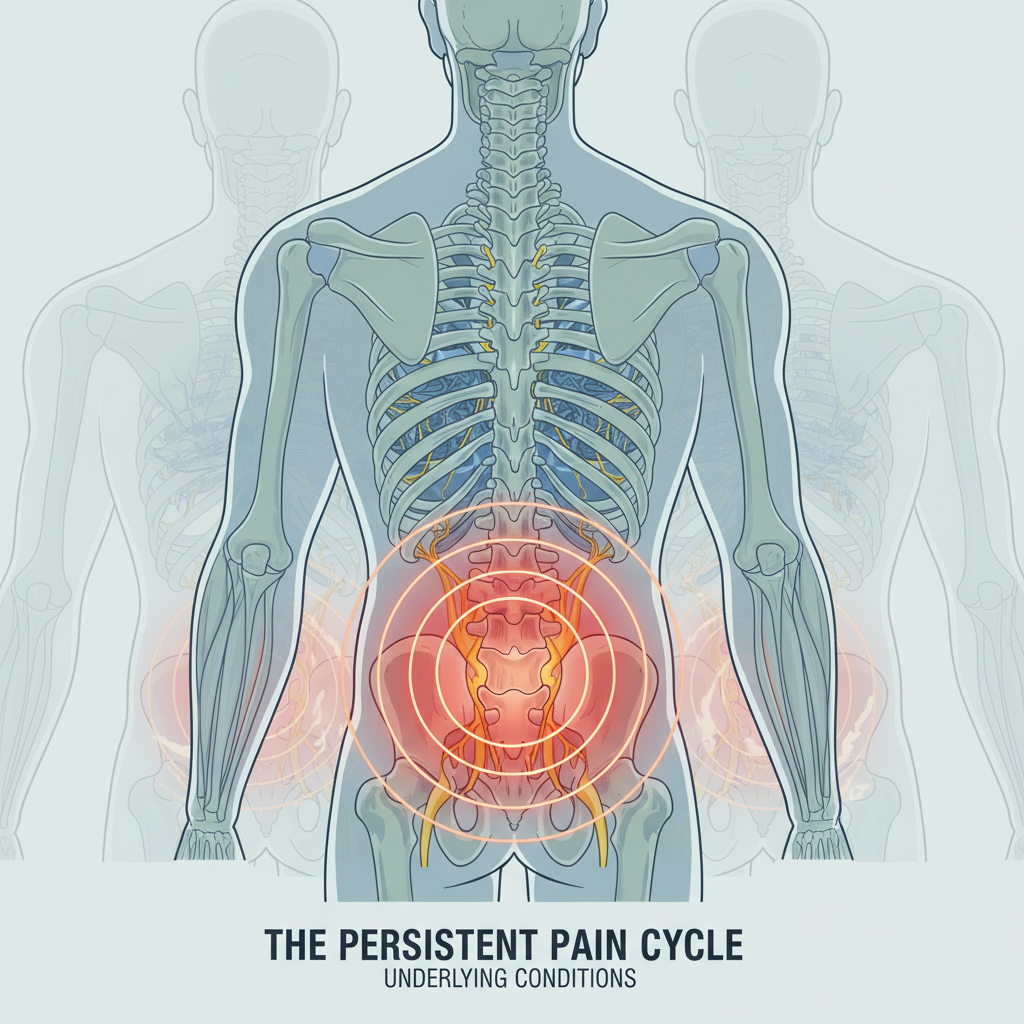
Back pain that improves for a while then flares up again can be frustrating and confusing. When you are living it, it can feel random or unlucky. In reality, there are clear reasons why back pain keeps coming back, and most of them have to do with underlying conditions, daily habits, and how your spine and muscles respond over time.
Understanding these patterns is an important first step. Once you know what is really driving your recurring pain, you are in a better position to work with your doctor or physical therapist on a plan that does more than just put out the next fire.
How common recurring back pain really is
You are not alone if your back pain seems to disappear, only to return weeks or months later. Chronic lower back pain affects up to 23 percent of adults worldwide, which means nearly one in four people live with ongoing or frequently recurring symptoms rather than a single short episode [1].
Many people who strain or sprain their lower back recover from the first episode without long term problems. However, a large number will have another episode within a year, sometimes from something as simple as lifting a box or twisting awkwardly [1]. This is one of the reasons back pain can start to feel like a cycle you cannot escape.
If you are wondering specifically about the structures involved in your discomfort, you might also find it helpful to read about common causes of lower back pain and what causes upper back pain.
Why back pain keeps coming back
Back pain recurs for a few broad reasons that often overlap. You might recognize one or several of these in your own experience.
1. The underlying cause never fully healed
Back pain is a symptom, not a diagnosis. If the underlying issue is not identified and addressed, the pain may ease temporarily but is likely to return.
The lumbar spine, which is the lower back, carries much of your body weight and allows you to bend, twist, and move. Any problem with the muscles, tendons, ligaments, joints, bones, or disks in this region can trigger pain that flares up repeatedly over time [1].
For example, a muscle strain might feel better after a week of rest and over the counter medication. If you then return quickly to heavy lifting or long days of sitting without rebuilding strength or flexibility, the same area can be easily irritated again. This pattern is common with:
- Incompletely healed muscle or ligament strains
- Disc injuries that are irritated again with bending and twisting
- Facet joint irritation, which can flare with repeated overuse
Sometimes the pain that keeps returning is a sign of a deeper or more persistent structural problem, not just a simple strain.
2. Degenerative conditions progress over time
Many recurring back problems are linked to gradual wear and tear in the spine. This is known as degeneration and it usually becomes more noticeable with age.
Conditions that can make back pain persist or return include:
- Osteoarthritis in the spine, which affects the small facet joints and can lead to inflammation, stiffness, and pain that worsens with activity [2]
- Degenerative disc disease, where the discs between vertebrae lose hydration and height over time, sometimes pressing on nerves and causing pain that is aggravated by bending and twisting [3]
- Osteoporosis, which can weaken the vertebrae and increase the risk of compression fractures and persistent back pain [4]
These issues do not typically resolve on their own. Instead, they require a combination of pain management, targeted exercise, and lifestyle changes to keep symptoms from worsening.
If you have noticed similar patterns in your neck, exploring topics such as why neck pain gets worse over time and why does my neck hurt all the time may be useful.
3. Nerve compression and structural problems
When spinal structures press on nearby nerves, pain can be persistent, sharp, or radiating. Flares often come and go as inflammation increases or your activity changes.
Common structural causes include:
- Herniated discs, where the soft inner material of a disc bulges or leaks out and presses on a nerve. This can be a result of injury or gradual wear and tear, and the pain can worsen or ease depending on position and activity [2]
- Facet joint arthritis or damage, which can cause local back pain and muscle spasms and may contribute to sciatica when nerves are irritated [2]
- Spinal stenosis, where the spinal canal narrows and compresses nerves, often causing pain that worsens with walking and improves when you sit or lean forward [2]
- Spondylolisthesis, scoliosis, or compression fractures, which can change spinal alignment and loading so that pain recurs with routine activities [2]
These conditions often need careful evaluation by a spine specialist. They may not require surgery, but they usually call for a long term plan instead of occasional rest.
4. Muscle deconditioning and inactivity
If you respond to back pain by moving less for long periods, your muscles can weaken, which you may hear described as muscle deconditioning or atrophy. Weakened core and back muscles are less able to support your spine. This can make even small movements feel painful and can increase your risk of repeat injuries.
Muscle deconditioning is one of the most common underlying drivers of chronic back pain [5]. It often develops gradually, especially if you sit for many hours a day or avoid exercise because you are afraid of making things worse.
Over time, this pattern can create a cycle:
Pain leads to rest and inactivity. Inactivity weakens muscles and stiffens joints. Weaker muscles and stiffer joints make pain more likely to return.
Research suggests that active physical therapy that focuses on movement, stretching, and strengthening is usually more effective for chronic back pain than relying on rest or surgery alone [5]. You can also explore how these principles apply to muscle tension vs spinal pain.
5. Daily habits that stress your spine
Often, the reason back pain keeps coming back is not a dramatic injury but the way you sit, stand, lift, and sleep day after day. These habits seem small in the moment but they add up.
Common lifestyle contributors include:
- Poor posture while sitting or standing, such as slouching at your desk or hunching over your phone, which puts continuous strain on the muscles and ligaments that support your spine [6]
- Improper lifting techniques, especially lifting heavy objects with your back instead of your legs or twisting while you lift. This is one of the most frequent triggers of repeated back pain episodes [7]
- Long periods of sitting, which can weaken your core and tighten your hip flexors and lower back, reducing support for the spine [8]
- Sleeping on a mattress that does not properly support your spine, which can keep your muscles under constant tension [8]
These same patterns can also affect the upper spine and neck. If you spend long days at a computer, it can be helpful to learn more about poor posture back pain causes and neck stiffness causes explained.
By becoming more aware of how you move and rest throughout the day, you can often reduce the constant low level strain that sets you up for the next flare.
6. Traumatic injuries that change how you move
A fall, car accident, or sports injury can start your back pain story. In some cases, the injury itself heals, but the way your body compensates does not.
Traumatic events can accelerate spinal aging and lead to chronic flare ups because your body adapts by favoring one side or moving in guarded patterns. Over time, these patterns place extra stress on other areas and can prolong pain well beyond the original injury [5].
Working with a physical therapist can help you retrain your movement so you are not living indefinitely in a protective posture that keeps your pain cycle going.
7. Chronic pain conditions and complex causes
Chronic back pain is often defined as pain that lasts longer than 12 weeks. It can be difficult to diagnose because several different factors may be involved at the same time, including:
- Previous injuries that never fully resolved
- Degenerative disc disease or arthritis
- Spinal stenosis or spondylitis
- Vertebral compression fractures from osteoporosis
- Conditions like fibromyalgia that change how your nervous system processes pain
A 2024 review from Harvard Health explains that recurrent back pain often stems from ongoing inflammation, nerve compression, or structural deterioration such as degenerative disc disease, and that finding an effective approach usually requires a combination of therapies and some trial and error [9].
This is one reason why back pain that returns again and again should not simply be written off as “normal.” It may be a sign that you need a more thorough evaluation and a more comprehensive treatment plan.
8. Stress, inflammation, and your overall health
Your back does not exist in isolation. Stress, diet, and overall health can all affect how often your pain flares and how intense it feels.
Higher stress levels can increase muscle tension and make inflammation worse, which can set off or amplify back pain episodes. At the same time, chronic pain itself increases stress, which can create a loop.
According to Harvard Health, adopting an anti inflammatory pattern of eating that includes plenty of antioxidants and omega 3 fats, along with losing excess weight if needed, can help reduce spinal pressure and calm inflammation so flare ups are less frequent and less severe [9].
Your daily activity level matters as well. A study cited by Harvard Health found that adding about 20 minutes of moderate to vigorous activity per day and cutting sedentary time by around 40 minutes helped prevent back pain from getting worse over time [9]. This is a reminder that you do not need extreme workouts. Consistent, manageable movement can make a real difference.
To see more about how these habits fit together, you can also look at how lifestyle affects back pain.
9. When surgery does not fully solve the problem
If you have had back surgery and you are still dealing with recurring pain, you might feel discouraged or confused. Several factors can lead to repeated pain after a procedure, sometimes referred to as failed back surgery syndrome.
Reasons pain can return include:
- The original surgery did not fully resolve the problem, or scar tissue developed that now irritates nerves
- Adjacent segment pathology, where vertebrae near the operated level start to degenerate or become painful later on [10]
- Progression of spinal degeneration over time in areas that initially appeared healthy [10]
- Returning to heavy work or intense exercise too soon after surgery, or not following through with rehabilitation recommendations [10]
Identifying why pain continues after surgery usually requires a careful review of your medical history, imaging, and surgical records, as well as a detailed physical exam. The success of further treatment can depend on both the specific cause of your pain and the health of your nerves and muscles [10].
How lifestyle keeps the pain cycle going
To understand why your back pain returns, it can help to look at how several common factors interact. Many people have more than one of these at the same time.
| Factor | How it contributes to recurring pain |
|---|---|
| Prolonged sitting | Weakens core muscles and stiffens the lower back, which makes the spine less supported and more easily irritated [8] |
| Poor posture | Places chronic stress on spinal structures, causing muscle imbalances and ongoing strain [11] |
| Inactivity | Leads to muscle deconditioning and reduced stability, increasing the chance of repeat injuries [5] |
| Improper lifting | Triggers strains and disc injuries, especially as you get older, and often sets off new flare ups [7] |
| Poor sleep support | Keeps muscles under tension overnight, so you wake up stiff and more vulnerable to pain [8] |
These factors are also relevant if you are dealing with both back and neck issues. Neck and upper back pain often share the same roots as lower back pain, including posture, muscle tension, and spinal alignment. You can explore this further in what causes chronic back pain.
What you can do about recurring back pain
Although the reasons behind recurring back pain can be complex, there are clear steps you can take to start changing the pattern. These are not quick fixes, but they help shift your spine and muscles toward better long term support.
Get a thorough evaluation
If your back pain keeps coming back, a detailed evaluation is important, especially if you have had symptoms longer than 6 to 12 weeks, or if they are worsening.
You may want to ask about:
- A full physical exam focused on posture, flexibility, strength, and nerve function
- Imaging, such as X rays or MRI, if your clinician suspects structural problems
- Screening for conditions like osteoporosis or inflammatory arthritis, depending on your age and symptoms
Because chronic back pain can have several overlapping causes, a clear picture can help you avoid chasing only the latest flare without addressing the main driver.
Commit to active rehabilitation
Research and clinical experience both point to active treatment as one of the most effective ways to manage persistent back pain.
With guidance from a physical therapist, you can work on:
- Strengthening your core and spinal stabilizers
- Improving flexibility in your hips, hamstrings, and back
- Practicing safe lifting and bending techniques
- Correcting movement patterns that developed after an injury
Over time, this can reduce the frequency and intensity of your pain episodes, even if underlying wear and tear in your spine is still present.
Adjust your daily habits
You do not control every factor that affects your back, but you have influence over many of them. Small, consistent changes can loosen the grip of recurring pain.
You might consider:
- Breaking up long periods of sitting with brief standing or walking breaks
- Setting up your desk and chair to encourage neutral posture, with your screen at eye level and your feet flat on the floor
- Using your legs and keeping your back straight when lifting, and avoiding twisting while carrying weight
- Choosing a mattress and pillows that keep your spine aligned in a neutral position
If you are dealing with both back and neck symptoms, aligning these daily habits with what you know about neck stiffness causes explained can make a noticeable difference.
Support your overall health
Since inflammation, stress, and general conditioning all influence back pain, it helps to think beyond the spine itself.
Steps that support your back include:
- Gradually increasing your daily movement, for example, adding a short walk after meals or taking the stairs when possible
- Choosing foods that are rich in vegetables, fruits, whole grains, and healthy fats to help reduce systemic inflammation [9]
- Working on stress management skills, such as mindful breathing, relaxation exercises, or counseling, to help reduce muscle tension and pain sensitivity
These changes are often easier to maintain when you see them as long term investments in how your body feels, rather than short term fixes.
When to seek more urgent help
Recurring back pain is common, but certain symptoms mean you should contact a doctor promptly or seek urgent care. These include:
- New or worsening weakness, numbness, or tingling in your legs
- Trouble controlling your bladder or bowels
- Severe pain after a fall, accident, or injury
- Unexplained weight loss, fever, or pain that is constant and not relieved by rest
Even if you do not have these red flag symptoms, it is reasonable to ask for help if your pain is interfering with sleep, work, or daily life, or if it has lasted longer than 6 to 12 weeks despite self care.
Understanding why back pain keeps coming back does not make the pain itself disappear, but it gives you a clearer map of what is going on. You may be dealing with more than one factor at the same time, such as degenerative changes, muscle deconditioning, and daily habits that strain your spine.
With a thoughtful evaluation, an active rehabilitation plan, and attention to how you move and live each day, you can begin to change the pattern and work toward more stable, sustainable relief.
References
- (Cleveland Clinic)
- (Houston Methodist)
- (Houston Methodist; Harvard Health Publishing)
- (Cleveland Clinic; ODPHP – Prevent Back Pain)
- (HealthPartners)
- (HealthPartners; Advanced Pain Care)
- (ODPHP – Prevent Back Pain)
- (Advanced Pain Care)
- (Harvard Health Publishing)
- (Samitivej Hospitals)
- (ODPHP – Prevent Back Pain; Advanced Pain Care)