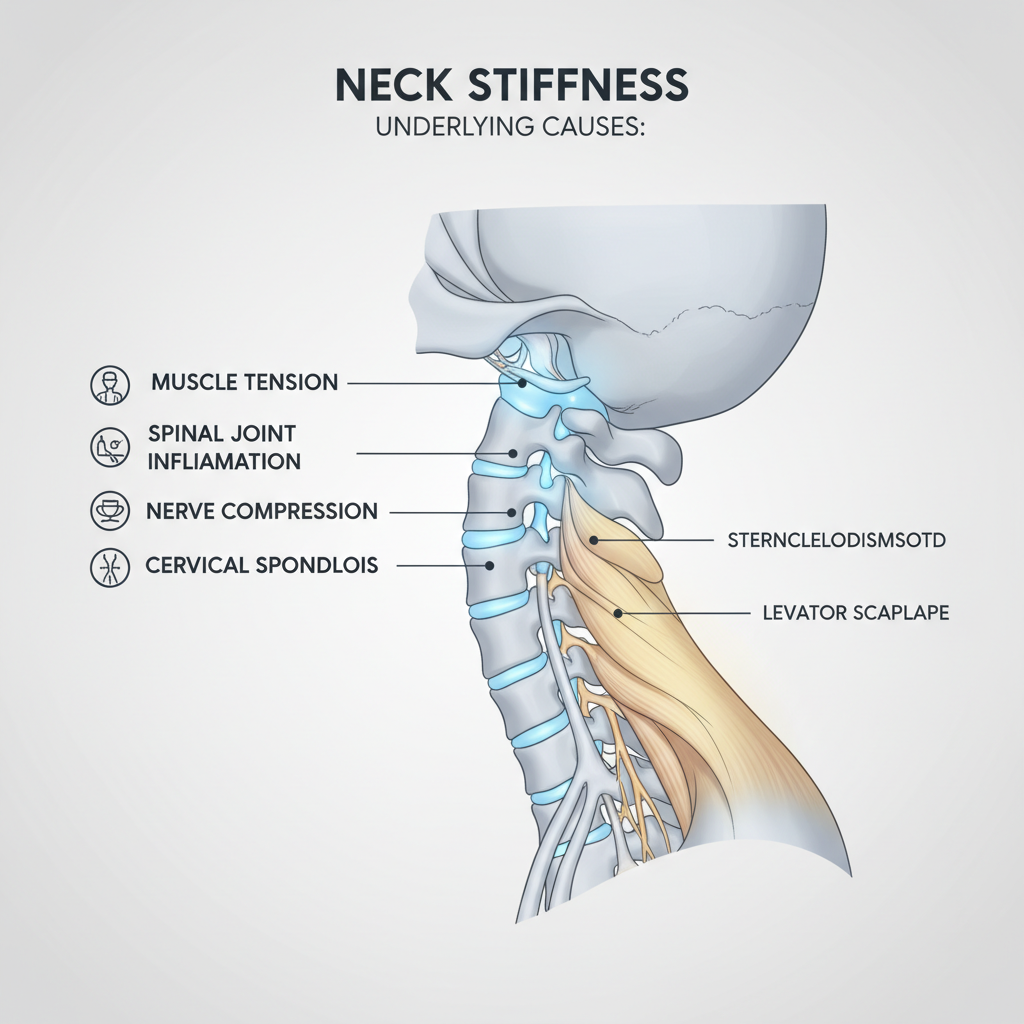
Neck stiffness causes explained: why it happens
If you wake up with a stiff neck or feel tightness that keeps coming back, you are not alone. Neck stiffness is one of the most common musculoskeletal complaints, and understanding the underlying causes is the first step to long‑term relief. In this guide on neck stiffness causes explained, you will explore how lifestyle, injuries, and structural problems in your spine can all play a role, and when stiffness is a warning sign you should not ignore.
Most neck stiffness is temporary and related to muscle overuse or awkward positions. However, recurring or severe stiffness can be linked to deeper issues, including arthritis, nerve compression, or even serious medical conditions. Learning to tell the difference will help you decide whether simple self‑care is enough or if you need medical attention.
What neck stiffness actually is
Neck stiffness is more than just discomfort. It usually means your neck has a reduced range of motion, so turning your head side to side or looking up and down feels tight, restricted, or painful.
According to Cleveland Clinic, stiffness often starts when the structures in your neck, including muscles, ligaments, joints, disks, and nerves, become irritated or damaged and then tighten up in response [1]. This can occur on its own or show up along with neck pain, headaches, or tingling in your shoulders and arms.
You might notice:
- Difficulty turning your head fully when driving
- A pulling or tight feeling in one side of your neck
- Pain that worsens after sitting or sleeping in one position
- Relief when you change posture or gently move your neck
When stiffness is mild and short lived, lifestyle habits are often to blame. When it is persistent, intense, or associated with other symptoms, it is more likely related to structural or medical conditions.
Common everyday causes of neck stiffness
Most people experience occasional neck stiffness that gets better on its own. In many cases, you can trace this back to how you use your neck throughout the day.
Poor posture and sustained positions
Your neck supports a head that weighs about 10 pounds. When you sit or stand in good alignment, your muscles share the load efficiently. When your head juts forward toward a phone or laptop, the strain increases significantly, which can quickly lead to fatigue and stiffness. Cleveland Clinic notes that poor posture and constant strain are major contributors to both neck pain and stiffness [2].
You are more likely to develop stiffness if you:
- Spend long hours hunched over a computer or phone
- Work at a desk that is not adjusted to your height
- Cradle a phone between your ear and shoulder
- Hold your head in one position while driving or reading
If you are also dealing with recurring upper back issues, you may find it helpful to explore related topics like poor posture back pain causes and what causes upper back pain.
Awkward sleeping positions
Sleeping in an unusual position or with inadequate pillow support can leave you waking up with a stiff neck. According to Cleveland Clinic, overusing neck muscles or sleeping in a position that strains them is one of the most common and usually temporary causes of a stiff neck [1].
You might notice stiffness if you:
- Sleep with multiple pillows that prop your head too far forward
- Use a very flat pillow that lets your head drop back
- Sleep on your stomach with your head turned sharply to one side
In these cases, stiffness often improves through the day as you move, stretch, and your muscles warm up.
Muscle overuse and strain
Overuse of neck and shoulder muscles can cause microscopic tears in muscle fibers. A chiropractic source explains that when this happens, your body triggers a protective response known as guarding, where the muscles contract involuntarily and stay tight to protect the injured area, which leads to marked stiffness and reduced movement [3].
This type of strain can occur when you:
- Lift heavy objects without proper form
- Perform repetitive overhead work
- Play certain sports or do new workouts that overload the neck and shoulders
Without proper treatment and gradual return to activity, these strains can lead to scar tissue that reduces flexibility and contributes to long‑term stiffness [3].
How stress and tension stiffen your neck
Emotional stress does not just live in your mind. Your body responds physically, and your neck is a prime target.
Baylor Scott & White Health explains that stress activates your fight or flight response, releasing hormones that cause neck muscles to tense as a protective reflex. If stress is constant, that tension can become chronic, leading to ongoing stiffness and discomfort [4].
Rehabilitation Physicians describe how this sustained tightening reduces circulation, irritates nerves, and puts pressure on joints in your neck, which can result in stiffness, soreness, and even tension headaches [5].
You may be dealing with stress‑related neck stiffness if:
- Your neck feels tighter as the day goes on
- Stiffness improves when you relax, stretch, or take a warm shower
- You also have headaches or aching in your shoulders and upper back
Because stress, posture, and general lifestyle often interact, you might notice that neck stiffness appears alongside back issues as well. Understanding how lifestyle affects back pain can give you a clearer picture of what is happening.
Injury‑related neck stiffness
Some neck stiffness develops suddenly after an accident or trauma. Injuries can affect muscles, ligaments, joints, and disks in your cervical spine, and stiffness is often one of the earliest signals that something is wrong.
Whiplash and sudden acceleration injuries
Whiplash is a common cause of acute neck stiffness. It typically occurs when your head is jerked rapidly forward and back, such as in a car accident or sports collision. This motion can strain muscles, ligaments, and even misalign cervical vertebrae, leading to deep pain and marked restriction in movement, sometimes extending into your shoulders and arms [3].
If you have had recent trauma and your neck quickly becomes stiff, you should:
- Limit sudden movements
- Seek a medical evaluation to rule out serious injury
- Follow professional guidance on rest, physical therapy, or rehabilitation
Ignoring whiplash and returning to full activity too quickly can increase your risk of long‑term stiffness and chronic pain.
Muscle strain from physical activity
Not all injuries are dramatic. You can strain your neck by:
- Lifting weights with improper technique
- Doing overhead work like painting a ceiling
- Carrying heavy bags on one shoulder
These activities can create the microscopic tears described earlier, leading to guarding and stiffness [3]. While many mild strains improve with rest and gentle movement, repeated strain without recovery can set the stage for recurring problems.
Underlying structural and degenerative causes
When stiffness persists or keeps coming back, structural changes in your cervical spine are often involved. Many of these conditions develop slowly over time and may also contribute to why your neck or back pain keeps returning.
Cervical spondylosis and age‑related wear
Cervical spondylosis is the medical term for age‑related wear and tear in the disks and joints of your neck. As disks shrink, bones may start to rub against each other, which can result in pain and stiffness [6].
You might suspect cervical spondylosis if you are middle‑aged or older and:
- Notice morning stiffness that improves somewhat during the day
- Feel grinding or cracking sensations when you move your neck
- Have both neck and upper back discomfort
Similar degenerative changes in the lower spine also explain some common causes of lower back pain, so if you have stiffness in multiple regions, wear and tear might be a consistent theme.
Herniated cervical disks and nerve irritation
When a disk in your neck bulges or herniates, it can press on nearby nerves. SEPA Pain and Spine notes that a herniated cervical disk can cause neck pain along with pain that travels into your hands and arms [6]. Harvard Health also highlights that neck pain and stiffness associated with pain traveling down one arm, weakness, numbness, or tingling may signal a herniated disk pressing on a nerve, which requires medical attention [7].
In these cases, stiffness can be your body’s way of limiting motion to reduce nerve irritation. If you experience these radiating symptoms, it is important to seek evaluation rather than relying on home care alone.
Spinal stenosis and nerve compression
Spinal stenosis occurs when spaces inside your spine narrow, putting pressure on your spinal cord and nerves. In the neck, this can lead to chronic pain, numbness or tingling in your hands, and weakness in your arms [6]. Stiffness is often part of this picture, especially when you try to move your neck beyond a limited range.
Because the spinal cord is involved, new problems with balance, coordination, or bowel and bladder control along with neck stiffness can signal spinal cord pressure and need immediate attention [7].
Inflammatory and systemic conditions
Sometimes neck stiffness reflects a broader health condition rather than a purely mechanical issue.
Rheumatoid arthritis and other inflammatory joint diseases
Rheumatoid arthritis is an autoimmune condition where your immune system attacks joint linings. SEPA Pain and Spine notes that it can affect the joints in your neck and cause pain, stiffness, and tenderness [6]. Inflammatory stiffness often:
- Is worse in the morning and lasts longer than 30 minutes
- Improves with gentle movement rather than rest
- Occurs along with joint problems in your hands, wrists, or other areas
These patterns are different from simple muscle strain and usually require evaluation by a health care provider.
Fibromyalgia and widespread pain
Fibromyalgia is a long‑term condition that causes widespread pain, fatigue, and tenderness. It is more common in women and can involve neck stiffness and muscle tenderness, sometimes with tingling in your arms [6].
If your neck stiffness is just one part of a broader pattern of body pain, poor sleep, and sensitivity to touch, fibromyalgia or another systemic pain condition may be contributing.
Serious causes you should not ignore
Although most stiff necks are not emergencies, there are situations where neck stiffness is a red flag. Understanding these can help you decide when to seek immediate care.
Meningitis and infection
Cleveland Clinic explains that a stiff neck can sometimes signal meningitis, a dangerous infection of the membranes around your brain that requires urgent treatment [1]. Continuum Wellness notes that meningitis is considered the most serious cause of neck stiffness and usually occurs with other signs such as headache, fever, nausea, or vomiting [8].
Harvard Health adds that neck stiffness combined with fever and headache may indicate bacterial meningitis, which needs prompt antibiotics [7].
You should seek emergency care immediately if neck stiffness appears with:
- Fever, severe headache, or confusion
- Nausea or vomiting
- A rapid worsening of symptoms
Persistent swollen glands in your neck along with stiffness can also point to infection or even a tumor and should be evaluated [7].
Tumors and other serious conditions
Continuum Wellness notes that tumors can sometimes cause neck stiffness and may represent a serious underlying issue [8]. Cervical dystonia, a movement disorder, can also cause chronic stiffness along with muscle spasms or difficulty moving your neck, which, while not an emergency, is still serious and needs specialist care [8].
Severe trauma followed by neck instability, such as being able to move your head much farther than normal, may indicate fractures or torn ligaments and should be treated as an emergency [7].
When to see a doctor for neck stiffness
It can be difficult to know when stiffness is just a nuisance and when it deserves more attention. Cleveland Clinic recommends seeing a provider if your stiff neck:
- Lasts more than a few days
- Keeps coming back
- Is accompanied by neurological symptoms like numbness, tingling, or weakness in your arms
- Comes with fever, confusion, nausea, or severe headache [1]
Harvard Health also highlights immediate evaluation if you notice:
- Pain or stiffness after significant trauma
- Pain traveling down one arm with weakness or numbness
- Loss of bowel or bladder control
- New severe headache with fever and neck stiffness [7]
If you are asking yourself why does my neck hurt all the time or why neck pain gets worse over time, those are also clear signals to involve a health professional instead of staying in a wait‑and‑see pattern.
How neck stiffness links to chronic pain patterns
Neck stiffness rarely exists in isolation. The same factors that affect your neck often influence your upper and lower back as well. Cleveland Clinic notes that neck pain and stiffness, known as cervicalgia, can stem from physical strain, poor posture, mental stress, osteoarthritis, spinal stenosis, herniated disks, pinched nerves, tumors, and other health conditions [2].
These kinds of issues can also be involved in what causes chronic back pain and why back pain keeps coming back. Understanding whether your primary problem is muscular, joint related, or nerve related can help you and your provider decide on the right treatment plan. Comparing muscle tension vs spinal pain can be particularly useful if you are trying to sort out what type of pain you are dealing with.
Self‑care and treatment options for neck stiffness
Treatment depends on the cause, but many conservative strategies can help reduce stiffness and prevent it from returning.
Cleveland Clinic recommends at‑home measures like:
- Adjusting posture at your desk and during daily activities
- Gentle neck movements, such as slowly tilting your neck away from the stiff side
- Exercises or stretches prescribed by a health care provider or physical therapist [1]
For neck stiffness linked to underlying conditions, treatment may include:
- Short‑term pain medication or anti‑inflammatory drugs
- Targeted exercises to strengthen your upper back and neck
- Stress management strategies to reduce muscle tension
- Referral to a spine or pain specialist for more complex cases [2]
Rehabilitation Physicians emphasize that lifestyle changes such as taking regular breaks from screens, improving ergonomics, staying active, stretching, and practicing relaxation or meditation can significantly reduce stress‑related neck stiffness [5].
For muscle strain and alignment issues, some people benefit from chiropractic care. For example, chiropractic adjustments have been used to restore vertebral alignment and joint mobility after muscle strain, helping muscles relax and reducing inflammation to prevent chronic stiffness [3]. Your own treatment plan should be guided by your provider based on your diagnosis, overall health, and preferences.
Putting it all together: understanding your neck stiffness
Neck stiffness is common, but repeated or long‑lasting stiffness is not something you need to simply live with. By understanding the most likely neck stiffness causes explained in this guide, you can start to identify patterns in your own symptoms:
- Short‑term stiffness after a poor night’s sleep or long day at your desk often points to posture or muscle overuse.
- Stiffness that comes with arm pain, tingling, or weakness suggests nerve involvement or disk problems.
- Morning‑dominant stiffness or stiffness with widespread pain may indicate inflammatory or systemic conditions.
- Stiffness with fever, severe headache, trauma, or neurological changes is a red flag that needs urgent care.
From there, you and your provider can address both the immediate discomfort and the root issues, whether those are lifestyle habits, structural changes, or broader health conditions. If your stiffness is one piece of a recurring pain pattern throughout your spine, exploring related topics like what causes upper back pain and how lifestyle affects back pain can help you take more informed steps toward lasting relief.